
Rapid growth is the dream. More orders, expanding customer base, rising revenue—every MSME works toward this moment. But here’s what most business owners don’t expect: growth creates pressure that exposes every weakness in your operations.
And the first place these cracks appear? Inventory.
For many MSMEs, inventory mistakes during rapid growth silently erase the gains from higher sales. You’re selling more but profiting less. You’re busier but not richer. The problem isn’t the growth itself—it’s that your inventory systems haven’t evolved to match it.
Mistake #1: Managing Inventory the Same Way You Always Have
This is where most problems begin.
The manual register that worked when you had 20 SKUs breaks when you have 200. The spreadsheet you updated weekly can’t keep pace with daily orders. The mental tracking that felt sufficient at smaller volumes becomes a liability under pressure.
What happens: Stock updates lag behind reality. Errors multiply. You make purchasing decisions based on outdated information. By the time you realize something’s wrong, you’ve already overspent or undersupplied.
Growth doesn’t just expose the limits of old methods—it punishes them.
Mistake #2: Overbuying in the Name of “Safety Stock”
Fear drives this mistake.
The logic feels sound: Better to have extra inventory than lose a sale. So you order more. You stock up. You create buffers upon buffers.
The hidden cost: Every rupee tied up in excess inventory is a rupee unavailable for salaries, marketing, equipment, or expansion. Your warehouse fills up while your bank account empties. You have stock, but you don’t have cash flow.
Suddenly, growth doesn’t feel rewarding—it feels expensive. You’re running harder just to stay in place.
Mistake #3: Underestimating Demand for Fast-Moving Items
While some products gather dust, others vanish faster than expected.
Without real-time visibility, you don’t see the pattern until it’s too late. Your bestseller runs out during peak season. Customer orders pile up. You scramble to restock, but the damage is done.
What you lose: Immediate revenue from lost sales. Long-term trust from disappointed customers. Growth momentum that took months to build.
The irony is painful—you have too much of what isn’t selling and not enough of what is.
Mistake #4: Losing Visibility Into What Actually Sells
Growth means more products, more variations, more complexity. Without proper tracking systems, the picture gets blurry.
You know you’re busy. Transactions are happening. The warehouse looks full. But which items are actually driving revenue? Which ones are just occupying expensive space?
The silent killer: Dead stock accumulates quietly. Capital remains blocked in products that will never sell. Your business looks active on the surface, but profitability stagnates underneath.
You can’t optimize what you can’t see.
Mistake #5: Keeping Inventory Separate from Billing and Sales
This disconnect creates chaos.
Products get sold, but stock levels don’t update. Invoices are raised without checking actual availability. You promise delivery dates based on incomplete information.
The cascade of problems: Customers receive wrong quantities. Disputes arise. Your team wastes hours reconciling mismatches. Trust erodes—both internally and externally.
During growth, these issues don’t just multiply—they compound. One error triggers three more.
Mistake #6: Building Dependency on Individual People Instead of Systems
As inventory complexity grows, many MSMEs rely on one or two key people who “know the stock.”
This person becomes indispensable. They hold critical information in their head. When they’re absent, sick, or overwhelmed, everything slows down. Mistakes increase. Operations stall.
The fundamental problem: You’ve built a business that depends on heroics rather than systems. Growth should make things easier through better processes, not harder through more pressure on individuals.
Sustainable growth requires systems that work independently of any single person.
Mistake #7: Reacting to Problems Instead of Preventing Them
The pattern becomes exhausting: discover a stockout, rush to reorder, overshoot to compensate, tie up cash, discover another gap, repeat.
You’re always playing catch-up. Always firefighting. Always one crisis away from the next.
What’s missing: Proactive management. Predictive visibility. Systems that warn you before problems arrive, not after they’ve already cost you sales and customer goodwill.
The Solution: Systems That Scale With Your Growth
These mistakes aren’t character flaws. They’re symptoms of outgrowing your systems.
What worked at ₹10 lakhs monthly revenue won’t work at ₹50 lakhs. What worked with 5 products won’t work with 50. Growth demands evolution.
How GrowInvoice Transforms Inventory Management
GrowInvoice was built specifically for MSMEs navigating this critical growth phase. It replaces guesswork with clarity, manual tracking with automation, and reactive firefighting with proactive control.
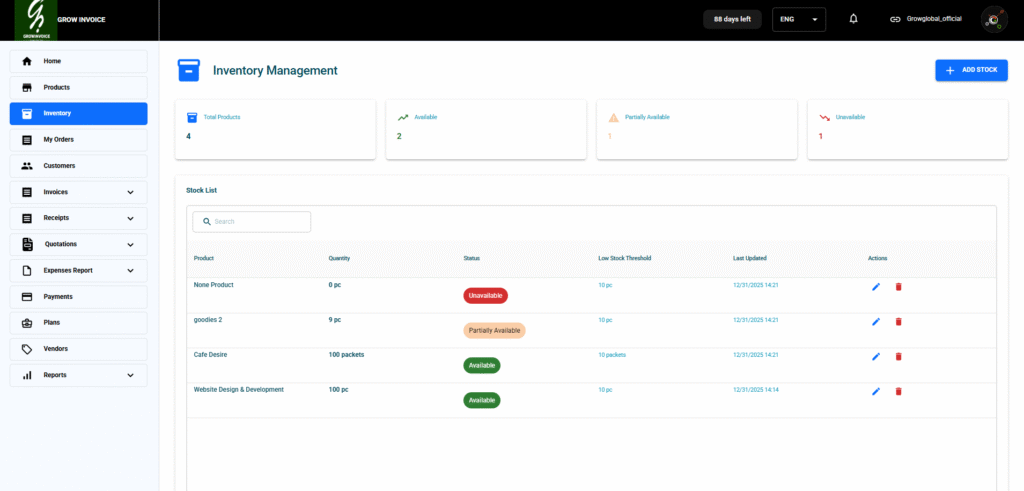
Automatic real-time updates: Every invoice, every sale, every stock movement updates your inventory instantly. No manual reconciliation. No data entry delays. Your inventory reflects reality at all times.
Complete visibility at a glance: See exactly what’s available, what’s running low, and what’s already sold out. Identify fast-moving and slow-moving items immediately. Make purchasing decisions based on actual data, not gut feeling.
Integrated inventory and invoicing: Stock and sales move together automatically. When you raise an invoice, inventory adjusts. When stock runs low, you know instantly. The disconnect that creates chaos simply disappears.
Smart alerts and insights: Get warned before stockouts happen. Spot overstocking trends early. Understand which products deserve more focus and which are draining resources.
System-driven, not person-dependent: Anyone on your team can access accurate, current inventory information. Operations continue smoothly regardless of who’s present. Knowledge belongs to the business, not just to individuals.
From Chaos to Control: What Changes
With proper inventory systems, growth transforms from exhausting to exciting.
Overstocking reduces because you buy based on clear patterns, not fear.
Stockouts become predictable instead of surprising, because you have advance warning.
Cash flow improves naturally because inventory aligns with actual sales velocity.
Decisions get faster because information is current and accessible.
As volumes increase, the system absorbs the complexity instead of passing it on to you. You scale the business without scaling the stress.
Building Discipline That Enables Sustainable Growth
Rapid growth should energize your business, not drain it.
When inventory is managed with clarity and control, MSMEs can scale confidently. You don’t block working capital in the wrong products. You don’t lose customers to avoidable stockouts. You don’t waste time reconciling disconnected systems.
GrowInvoice helps you build this discipline early, when it matters most—so growth strengthens your business instead of stretching it dangerously thin.
Final Thoughts: Inventory as Growth Enabler, Not Growth Bottleneck
Inventory mistakes during rapid growth are common. But they’re not inevitable.
They happen when systems lag behind scale. When manual processes outlive their usefulness. When complexity grows faster than control.
The good news: You can fix this before it breaks your growth momentum.
GrowInvoice turns inventory from a constant headache into a strategic advantage. From a growth bottleneck into a growth enabler.